

Travel Advisor
What Is Backpacking Travel? The Word Means Two Different Things
One word, two activities that share almost nothing but a bag. Which one you mean changes the gear, the cost, the risk and the skills, so it is worth settling first.
Two different problems get sold as one product. Entry footwear needs a sole; swimming needs a fin. Solving both with one item is where most purchases go wrong.
Affiliate disclosure. This guide contains affiliate links, including Amazon Associates links. If you buy through one, Smart Travel Info may earn a commission at no additional cost to you. Selection is based on sole construction, fit and compatibility with fins. Commission rates play no part in the ranking. See our editorial policy.
Two different problems get sold as one product, and most bad purchases in this category come from that confusion.
Getting in and out needs a sole: protection from rock, coral rubble, urchins and hot sand.
Moving through the water needs a fin: a blade that converts leg movement into propulsion.
A sole stiff enough to protect you creates drag when you swim. A blade efficient enough to propel you offers nothing on a rocky entry. Nothing resolves that trade-off, which is why the honest answer for most shore snorkelling is both: shoes to walk in, and either open-heel fins that fit over them, or fins carried and swapped at the water's edge.
| Situation | Footwear |
|---|---|
| Snorkelling from a boat | Not needed. Deck grip is the only concern |
| Sandy beach entry, calm water | Optional, mostly for hot sand on the walk down |
| Rocky or reef entry | Yes, genuinely protective |
| Volcanic rock, urchins, oyster beds | Yes, and take it seriously |
| Long walk from a car park in summer | Yes, and this is the use people forget |
Hot sand is the underrated one. Midday sand reaches temperatures that burn, and it catches out more visitors than anything in the water.
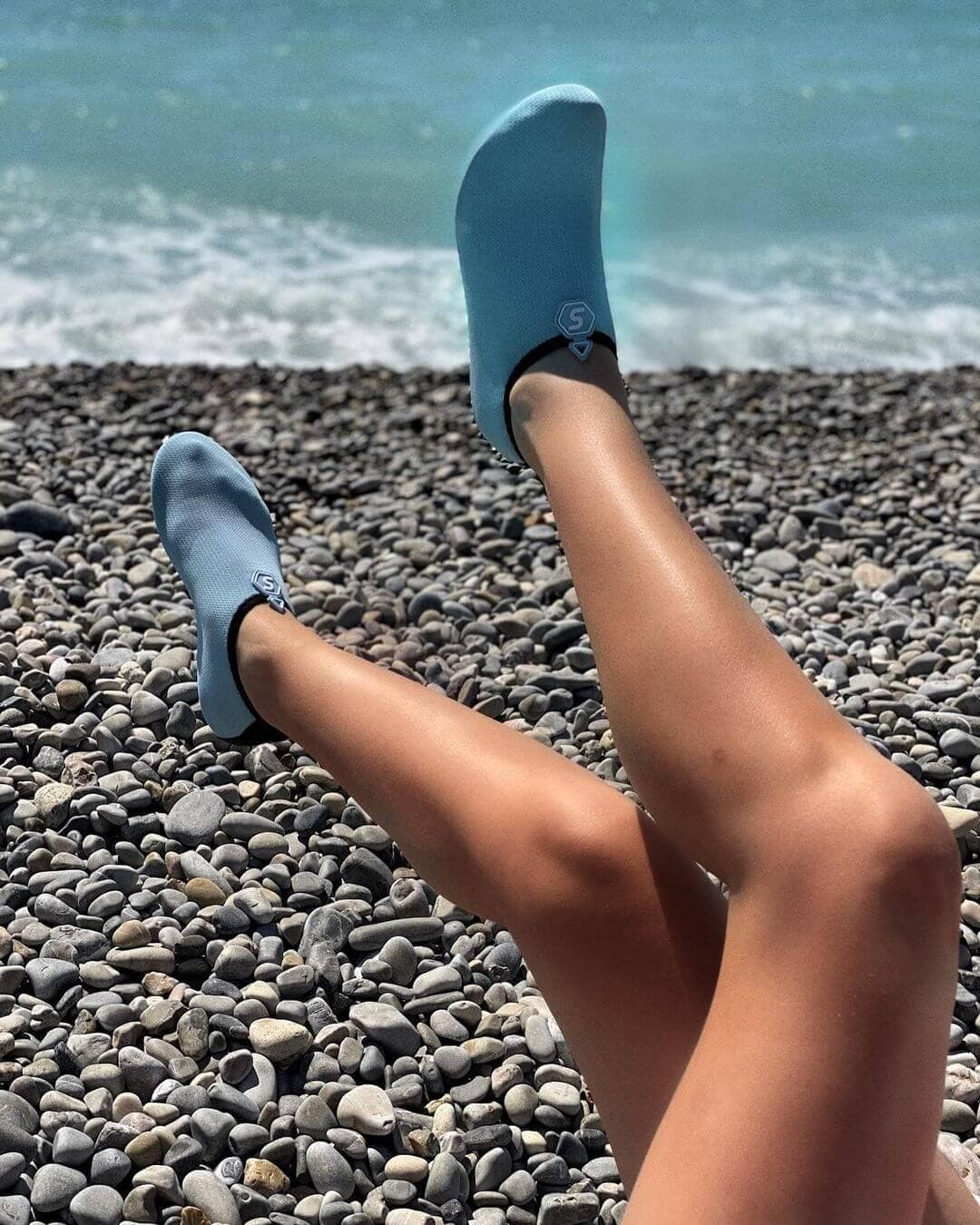
A real rubber sole with tread. Thick enough that you cannot feel a sharp stone through it when you press. Sock-style shoes with a printed grip pattern are comfortable and protect you from very little.
Snug fit, no heel lift. Loose water shoes fill with sand, which then scrubs your skin. Wet mesh and neoprene soften slightly, so a pair that is comfortably snug when dry is about right in the water.
Drainage. Perforations or a mesh upper so they empty when you walk out. Shoes that hold water are heavy and take days to dry.
A secure closure. Bungee lace with a toggle, or a hook-and-loop strap. Slip-on shoes come off in surf.
Quick-drying materials. Mesh and neoprene rather than anything padded or foam-filled, which stays wet and smells.
Open-heel fins have an adjustable heel strap and a foot pocket built to take a boot. These are the ones that work with water shoes.
Full-foot fins are sized to a bare foot and enclose the heel. They will not fit over a shoe, and forcing the issue produces blisters and a fin that falls off.
Decide which system you are on before you buy either half of it.
The mainstream category: quick-dry mesh upper, bungee lace, moulded rubber outsole with real tread. Widely available from several brands at low cost, and the specification matters more than the name on them.
Thicker, warmer and considerably more protective, with a proper sole and a zip or pull-on ankle. These are what you want on volcanic rock or in water cold enough to matter, and they are designed to go inside open-heel fins.
Adjustable heel strap, foot pocket sized for a boot. This is the system that lets you walk in over rock and then swim efficiently, and it is what most shore snorkellers should be on.
Short-bladed fins sized to a bare foot, which pack into a carry-on and are efficient enough for surface snorkelling. The right choice when you are getting in from a boat or clean sand and do not need footwear at all.
The same requirements, with one addition: a closure a child can operate. Children take shoes off in the water and lose them, so a snug fit and a secure strap matter more here than anywhere else.
Rinse in fresh water after every use, including the inside. Salt and sand left in a shoe destroy the lining and produce a smell that never fully leaves.
Dry them fully, out of direct sun where possible, since prolonged UV degrades the glue holding soles on. Store them dry and loose rather than compressed in a bag.
That is the whole maintenance requirement, and following it roughly doubles how long a cheap pair lasts.
Footwear is the smaller half of the snorkelling decision. Our guide to how a snorkel works covers inhalation resistance and the safety findings that should shape which mask and snorkel you buy, and our full face mask guide covers that design specifically.
Decide how you will enter the water, because that determines everything else. Boat or clean sand means full-foot fins and no shoes. Rock, reef or a long hot walk means boots or water shoes plus open-heel fins.
Then buy both halves of that system together, because the single most expensive mistake here is a set of full-foot fins and a pair of water shoes that will never work with each other.
For the entry and exit, usually yes, on any shore with rock, coral rubble, urchins or hot sand. Once you are swimming they add drag and do nothing useful. From a boat, they are optional.
Only with open-heel fins, which have an adjustable strap and a foot pocket sized to take a boot. Full-foot fins are sized to a bare foot and will not fit over a shoe. Buying full-foot fins and then trying to wear them with shoes is the most common mistake in this category.
Rubber, with a defined tread, thick enough that you cannot feel a sharp stone through it. Thin sock-style soles are comfortable and offer very little protection, which is the wrong trade-off on reef or volcanic rock.
Snug, with no heel lift. Loose shoes fill with water and sand and scrub your skin raw. Wet neoprene and mesh soften slightly, so a pair that is comfortably snug dry will be right wet.
They protect your feet, they do not protect the coral. Standing on live coral kills it regardless of what is on your feet. If you need to stand, find sand.
Yes, and this is an underrated use. Sand at midday can reach temperatures that burn feet on a walk from the car park, and it catches out visitors far more often than anything in the water.
Usually not for the water. Deck shoes or something with grip for a wet boat deck is a reasonable idea, but you can go in and out without footwear entirely.
One word, two activities that share almost nothing but a bag. Which one you mean changes the gear, the cost, the risk and the skills, so it is worth settling first.
Two decisions cover almost everything: get the length right for your weight, and choose a continuous rocker. Everything else is preference and price.
Bleach is the reflex and it is the wrong tool on chair fabric. It removes the stain, leaves the growth, and wrecks the colour. Here is the method that works.