

Travel Advisor
What Is Backpacking Travel? The Word Means Two Different Things
One word, two activities that share almost nothing but a bag. Which one you mean changes the gear, the cost, the risk and the skills, so it is worth settling first.
From January 2025 the label on a life jacket stopped saying Type III and started saying a performance level. If you are buying a vest, this is the thing to understand first.
Affiliate disclosure. This guide contains affiliate links, including Amazon Associates links. If you buy through one, Smart Travel Info may earn a commission at no additional cost to you. Selection is based on published approval status and fit for towed watersports. Commission rates play no part in the ranking. See our editorial policy.
The label changed. From 6 January 2025, manufacturers began marking life jackets under the Coast Guard and Transport Canada Performance Level system, replacing the Type I to V classification most guides still use.
Watersports vests that used to say Type III now sit at Level 50.
Both labels are legally in circulation, because existing approvals stay valid. So you will see Type III and Level 50 side by side on the same shelf for years, describing the same thing, and neither is wrong.
| Level | Intended for | Replaces roughly |
|---|---|---|
| 50 | Competent swimmers, calm near-shore water, worn during activity | Type III |
| 70 | General recreational boating in calm water | Type III / II |
| 100 | Sheltered water where rescue may not be immediate | Type II |
| 150 | Offshore, rough water, extended survival | Type I |
Level 50 is the wakeboarding number. It provides flotation and allows unrestricted movement, and it is explicitly not designed to turn an unconscious person face-up. That is the compromise a watersports vest makes, and it is the correct one for a sport where you need to swing your arms.
The new labels also lean on pictograms rather than dense text, which makes the intended use readable regardless of language.
Look for the approval statement and approval number on the label. That is what makes a device count. A vest with no approval statement is a garment, whatever the marketing says about safety.
This is the single most common mistake in this category.
Impact vests are close-fitting neoprene vests sold for comfort and for reducing the sting of hitting water at speed. Many are explicitly labelled "not a Coast Guard approved personal flotation device."
They look like life jackets. They are worn like life jackets. They are not life jackets, and they do not satisfy any legal requirement for towed watersports.
If you want one for the comfort, that is a legitimate choice for an experienced rider at a cable park where local rules allow it. Just do not buy one thinking you have bought flotation.
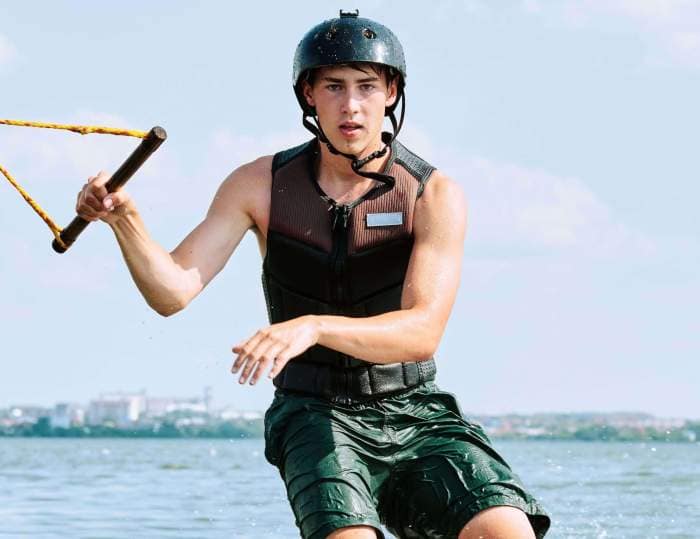
Segmented panels. A vest with flotation split into several panels front and back bends with your torso. A single slab does not, and you will feel it every time you crouch.
Short cut. It should end above the top of your hips so it does not jam into your ribs when you bend forward, which is the position you spend most of a session in.
Side entry and buckles. Front-zip vests can be pulled apart on a hard impact. Side-entry designs with a zip and multiple buckles hold better at speed.
Fit tight. Tighter than feels natural on land. The test is the shoulder pull: fasten it, have someone pull firmly upward on the shoulder straps, and see if it moves toward your ears.
Neoprene or nylon. Neoprene fits closer, moves better and keeps you warmer, and it costs more and dries slowly. Nylon adjusts over a wider size range, dries fast and is cheaper, which makes it the right answer for a vest that several people will share.
Availability and pricing move constantly, so these are selected on approval status, construction and fit for towed sports. Confirm the current label and approval on the listing before you buy, since manufacturers revise models between seasons.
The long-standing default approved neoprene vest for towed sports. Segmented panels, side entry, and a cut that stays out of your ribs. Buy this if you ride regularly and want one vest that works.
A Coast Guard approved neoprene vest at a lower price than the premium options, in a unisex cut. The CGA in the name is the thing to look for; Hyperlite sells non-approved comp vests under similar names.
Women-specific shaping matters here more than in most gear, because a unisex vest that fits the chest usually does not fit the torso length, and a vest that is too long jams into the hips when you crouch.
Youth vests are sized by weight band, not age, and the bands are narrow. A vest one band too large will come off over a child's head in the water, which is exactly the scenario it exists for.
Standard approved nylon watersports vests adjust across a wide size range, dry quickly and cost a fraction of neoprene. On a boat where different people ride, several of these beats one expensive vest that fits one person.
Foam degrades, straps fray and buckles crack, usually somewhere in a garage.
A vest stored wet in a boat locker for two winters should be replaced rather than trusted, and they are not expensive enough to argue about.
Once you have the vest, our beginner's guide to wakeboarding covers the boat speed and rope length that decide whether a first session works, and our beginner wakeboard guide covers sizing by weight.
Read the label before anything else. You are looking for an approval statement and number, and either Level 50 or the older Type III. If neither is there, it is an impact vest and not a life jacket.
Then fit it properly and run the shoulder-pull test. A correctly labelled vest worn loose protects nobody.
Performance Level 50. From 6 January 2025 manufacturers began labelling under the Coast Guard and Transport Canada Performance Level system, using Levels 50, 70, 100 and 150 in place of the old Types. Watersports vests sit at Level 50.
Yes. Existing approvals remain valid and a serviceable Type III vest still counts as an approved device. The change affects labelling on new products, which is why you will see both systems on the shelf for years.
A device intended for competent swimmers in calm, near-shore water, worn during activity. It provides flotation but is not designed to turn an unconscious person face-up. That is the trade-off it makes in exchange for allowing movement.
In practice, yes. Requirements for towed watersports are set by state, and an approved device is the standard everywhere. Check the label for the approval statement and number. If it is absent, the vest does not count regardless of how it is marketed.
A close-fitting neoprene vest sold for comfort and impact protection at high speed. Many are explicitly labelled as not Coast Guard approved. Those are not life jackets and do not satisfy any legal requirement, and buying one by mistake is the most common error in this category.
Tight. Fasten it, then have someone pull firmly upward on the shoulders. If it moves toward your ears it is too loose or too large. A vest that rides up on impact is both useless and painful.
Neoprene fits closer, moves better and holds warmth, at more cost and slower drying. Nylon is cheaper, dries faster, adjusts across a wider size range and is the better choice for a shared boat vest.
One word, two activities that share almost nothing but a bag. Which one you mean changes the gear, the cost, the risk and the skills, so it is worth settling first.
Two decisions cover almost everything: get the length right for your weight, and choose a continuous rocker. Everything else is preference and price.
Bleach is the reflex and it is the wrong tool on chair fabric. It removes the stain, leaves the growth, and wrecks the colour. Here is the method that works.